A 2025 clinical guideline from the US Departments of Veterans Affairs and Defense strongly recommends polysomnography or home sleep apnea testing for clinically suspected obstructive sleep apnea (OSA). The same guideline treats the STOP questionnaire as a screening tool that identifies people who need further evaluation, not as a diagnostic test.
Snoring is one clue, not the dividing line between primary snoring and OSA. The US National Heart, Lung, and Blood Institute lists breathing that starts and stops, frequent loud snoring, gasping, daytime sleepiness, morning headaches and repeated nighttime urination among possible sleep apnea symptoms.
Awake breathing trouble and dangerous sleepiness need immediate action
A witnessed pause during sleep belongs in a clinical assessment, but it is different from a person suddenly stopping breathing while awake. MedlinePlus, a service of the US National Library of Medicine, calls for the local emergency number when someone collapses, cannot breathe or is unresponsive; a routine sleep appointment should not delay that response.
The American Academy of Sleep Medicine says drowsiness reduces attention, delays reactions and impairs decisions, and it advises a sleepy driver to leave the road at a safe location. Repeated difficulty staying awake while driving or doing safety-sensitive work calls for the activity to stop and for prompt medical assessment.
The symptom pattern matters more than snoring volume
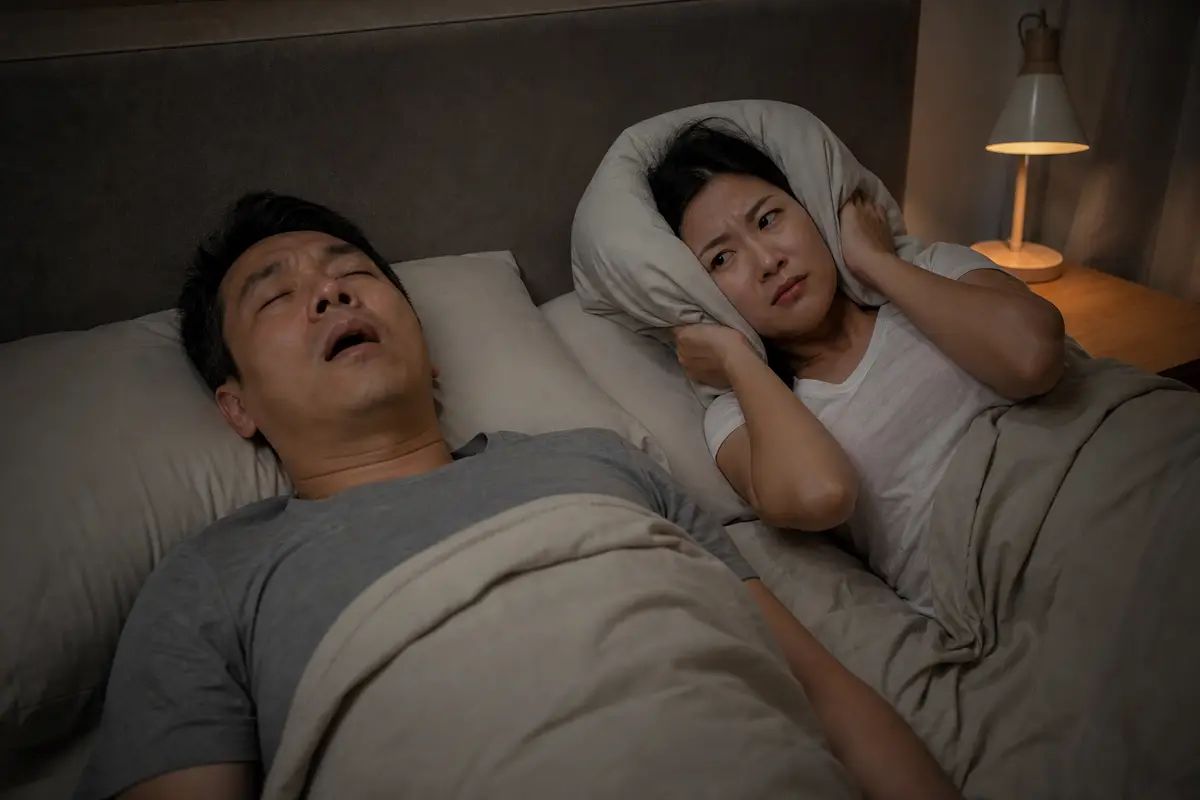
The symptom pattern can include breathing that repeatedly stops and restarts, loud snoring, gasping, daytime sleepiness, fatigue, poor concentration, a dry mouth, morning headache or frequent nighttime urination. A bed partner may notice the nighttime events before the person affected does.
The American Academy of Sleep Medicine's 2017 adult guideline defines increased risk of moderate to severe OSA as excessive daytime sleepiness plus at least two of three findings: habitual loud snoring, witnessed apnea or gasping or choking, and diagnosed hypertension. That combination helps clinicians select uncomplicated adults for testing; it does not diagnose OSA at home.

A questionnaire can flag risk but cannot diagnose OSA
STOP and STOP-Bang ask about features associated with OSA and can structure an initial assessment. The 2017 American Academy of Sleep Medicine guideline strongly recommends against using clinical tools, questionnaires or prediction algorithms to diagnose adult OSA without polysomnography or home sleep apnea testing.
A high score therefore means that further evaluation may be warranted, not that treatment should begin automatically. A low score also cannot explain every cause of daytime sleepiness, morning headache or disrupted sleep.
Home and laboratory tests serve different patients
The US National Heart, Lung, and Blood Institute says laboratory polysomnography records brain waves and monitors heart rate, breathing and blood oxygen during sleep. The 2017 American Academy of Sleep Medicine guideline calls polysomnography the standard diagnostic test when a comprehensive sleep evaluation raises concern for adult OSA.
The American Academy of Sleep Medicine limits home sleep apnea testing to uncomplicated adults with signs and symptoms that indicate increased risk, and says it should not screen an asymptomatic population. Under that US position, a clinician should order the test and a sleep physician should review the raw data rather than relying only on automatic scoring.
The academy recommends laboratory polysomnography after one negative, inconclusive or technically inadequate home test. It also favors laboratory testing over a home test for people with significant cardiorespiratory disease, possible respiratory muscle weakness, awake or suspected sleep-related hypoventilation, chronic opioid use, a history of stroke or severe insomnia.
Treatment starts after objective diagnosis
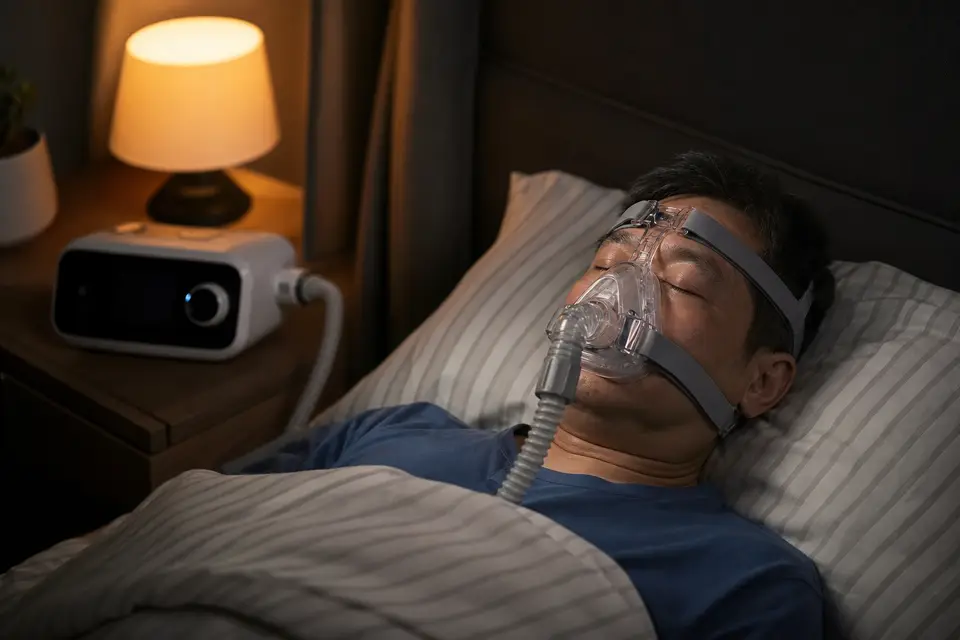
The American Academy of Sleep Medicine's 2019 guideline strongly recommends positive airway pressure (PAP) for adults with diagnosed OSA and excessive sleepiness. It says PAP should follow objective testing and should include follow-up that checks effectiveness, use and problems with the equipment.
Continuous positive airway pressure (CPAP) delivers a set pressure, while auto-adjusting positive airway pressure (APAP) changes pressure during sleep. The 2019 guideline strongly recommends either CPAP or APAP for ongoing treatment in adults, but the device, mask and settings require an individualized plan.
A 2015 joint guideline from the American Academy of Sleep Medicine and American Academy of Dental Sleep Medicine says sleep physicians should consider oral appliances for adults who cannot tolerate CPAP or prefer an alternative. When an appliance is prescribed, the guideline favors a custom, titratable device fitted by a qualified dentist over a noncustom device.
The same guideline calls for dental oversight to detect tooth or bite changes and for follow-up sleep testing to confirm effectiveness. An over-the-counter mouthpiece cannot establish that OSA is controlled, even if snoring becomes quieter.
Weight management applies when overweight or obesity is present
The American Thoracic Society's 2018 guideline strongly recommends a comprehensive lifestyle intervention for adults with OSA who are overweight or obese, combining a reduced-calorie diet, physical activity and behavioral guidance. The reviewed interventions were associated with improvements in apnea severity and quality of life, but the studies had methodological limits.
The recommendation does not mean that every adult with OSA is overweight or that weight loss guarantees the condition will disappear. The US National Heart, Lung, and Blood Institute says follow-up testing may be needed after substantial weight gain or loss, so another prescribed treatment should not change without reassessment.
Long-term risks are not an individual forecast
The US National Heart, Lung, and Blood Institute says untreated sleep apnea may raise the risk of cardiovascular disease, stroke, type 2 diabetes and other conditions. These are population-level associations and do not predict which complication, if any, one person will develop.
Effective treatment can target breathing events, oxygen disruption, sleepiness and sleep-related quality of life. The cited guidelines do not support promising that one treatment will prevent every heart attack, stroke or diabetes diagnosis.
Children and pregnancy follow separate pathways
The American Academy of Pediatrics' 2012 childhood guideline recommends polysomnography or specialist evaluation when a child regularly snores and has signs or symptoms of OSA. Children may show hyperactivity, bedwetting or school attention problems, so the adult symptom threshold and home-testing rules should not be copied into pediatric care.
A July 2026 American College of Chest Physicians guideline issued nine conditional recommendations for OSA in pregnancy, including risk screening, objective testing and postpartum reassessment for some patients. The panel rated the certainty as low, so pregnancy requires an obstetric and sleep-medicine plan rather than the routine adult pathway described above.
The cited US guidelines do not create a worldwide testing or treatment policy. APPI News could not verify one global rule for sleep-test eligibility, device prescribing, regulatory status or coverage; local health systems set those arrangements.
Frequently asked questions
Does loud snoring mean OSA?
No. Loud snoring can raise suspicion, especially with witnessed breathing pauses, gasping or daytime sleepiness, but an objective sleep test is needed for diagnosis.
Can a questionnaire confirm OSA?
No. STOP, STOP-Bang and similar tools can identify risk and support referral, but the guidelines cited here do not accept them as stand-alone diagnostic tests.
Does a negative home test rule OSA out?
Not always. A negative, inconclusive or technically inadequate home test can require laboratory polysomnography or another test when clinical suspicion remains.
Is a noncustom anti-snoring mouthpiece equivalent to a prescribed appliance?
No. The joint sleep and dental guideline favors a custom, adjustable appliance with dental oversight and follow-up sleep testing when oral appliance therapy is chosen.
Is PAP the only treatment?
No. PAP has strong evidence for adults with OSA and excessive sleepiness, while a prescribed oral appliance or weight management for people with overweight or obesity may fit different cases.
Sources and further reading
- VA/DoD Clinical Practice Guideline for the Management of Chronic Insomnia Disorder and Obstructive Sleep Apnea: Provider Summary(US Department of Veterans Affairs and US Department of Defense)
- Sleep Apnea Symptoms(US National Heart, Lung, and Blood Institute)
- First Aid(US National Library of Medicine)
- Drowsy Driving Health Advisory(American Academy of Sleep Medicine)
- Clinical Practice Guideline for Diagnostic Testing for Adult Obstructive Sleep Apnea(American Academy of Sleep Medicine)
- Sleep Studies(US National Heart, Lung, and Blood Institute)
- Clinical use of a home sleep apnea test(American Academy of Sleep Medicine)
- Treatment of Adult Obstructive Sleep Apnea with Positive Airway Pressure(American Academy of Sleep Medicine)
- Clinical Practice Guideline for Oral Appliance Therapy(American Academy of Sleep Medicine and American Academy of Dental Sleep Medicine)
- The Role of Weight Management in the Treatment of Adult Obstructive Sleep Apnea(American Thoracic Society)
- Sleep Apnea: Living With(US National Heart, Lung, and Blood Institute)
- Diagnosis and Management of Childhood Obstructive Sleep Apnea Syndrome(American Academy of Pediatrics)
- OSA in Pregnancy: An American College of Chest Physicians Clinical Practice Guideline(American College of Chest Physicians)